The Human Connection
 | IntroductionThis website is devoted to the explannation and my senior research paper. It centers around the concept of The Human Connection. I bring together a variety of theories and concepts and hope to guide one through my paper. John Gowan, a retired Professor of Cornell University, said, "There is simply too much to know these days, and we suffer more from a lack of unifying theory than we do from a lack of specialized expertise. " I aim to do the same and relate multiple theories and enlighten one to not only the brilliance of each one, but the how they can function together. |
Six Degrees of Separation
In John Guare's play, Six Degrees of Separation, he conveys the idea that all of mankind is connected: "I read somewhere that everybody on this planet is separated by only six other people. Six degrees of separation. Between us and everybody else on this planet. How every person is a new door, opening up into other worlds. But to find the right six people” (81). This is where my interest originated. In 1994, Kevin Bacon stated in an interview that he had worked with everybody in Hollywood or someone who's worked with them. This concept quickly escalated into a popular trivia game. The trivia game became a board game. The board game became a interactive game on the web. The website game became a headliner on The Onion magazine that read, "Kevin Bacon Linked to Al-Qaeda". And in 2007 Kevin Bacon started a charity organization called SixDegrees.org. The small world phenomenon theory grew like wildfire: Six degrees of separation between all of humanity. Society is becoming more interrelated, but is struggling to find the right kind of connections. How many of these degrees of separation are violent ones? If one were to turn on the news he or she would likely see one culture fighting another based on conflicting religious views or racial violence. Humanity has historically achieved more success closing doors, not opening them as Guare stated. The degrees of separation among mankind might be getting closer, but the human connection is not.
**Here are the links for Kevin Bacon's interactive online game and charity foundation for those that are interested.
The Oracle of Bacon Online Game: http://oracleofbacon.org/help.php
Charity Foundation: http://www.sixdegrees.org/
Physical Connections
Carl Sagan once said, “We are all made of star stuff” (“Carl Sagan Quotes”). Sagan is right. Mankind is made up of recycled carbon dating back to the Big Bang. Through evolution it has matured into a coagulation of atoms arranged in millions of different ways. Recognizing that man is made of the same substances might help society value one another more. This knowledge would help put an end to racial violence especially. The only known major difference between a white and black man is the amount of melanin, a chemical that affects skin tone. Melanin, next to adrenaline, is probably the chemical responsible for the most deaths in history. This one anomaly is the primary factor in centuries of racial persecution. Society needs to recognize this as a minuscule difference beyond one’s personal control and not hold others accountable for being different. One could even argue that there is not even a difference of materials, just a difference of arrangement of the atoms. The majority of people probably understand their shared physical structures; however it does not really register. Man needs to learn to let this connection resonate and take pride in it. These similarities need to seep below recognition and into appreciation. People all interact with the environment to attain the basic necessities for life. John Gowan stated, “We are social animals, out of necessity for self-defense and common survival” (10). This is ironic in some ways as social nature often brings about the destruction of common survival. This is the flaw in the human connection. Society may be connected by six people on a name basis, but fails to relate. If mankind could acknowledge that it is all part of the same species and is made up of the same materials, it could further advance the human species as a whole. Different cultural groups often feud over their beliefs more than the biological differences. The near identical physical frameworks set the stage for shared physiological similarities as well. | 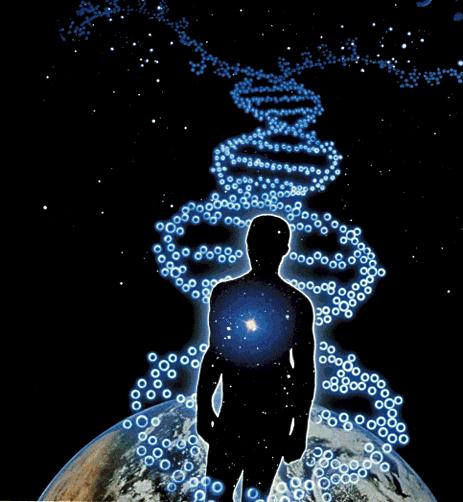 |
Psychological Connections
The interrelation between humanity reaches much deeper than just the physical similarities. Humans have the ability of abstraction, or the ability to reflect upon one’s actions and consider something as a general quality or characteristic, apart from concrete realities, specific objects, or actual instances. In his paper “The Human Connection”, Gowan speaks of society’s psychological connections and their role in creating religions.
The origins of human spirituality lie in our animal feelings of connection, but are developed out of these through the abstracting abilities of our minds into the elaborate religious forms we see today…In the “spiritual” interpretation, death becomes not a loss of connection, but a return to the pure realms of connection itself- life becomes in fact a lesser expression because the body “contaminates” or interferes with the essence of connection, spirit. This concept eventually took the extreme form that life itself was to be valued less than spirit. (2, 3)
This observation goes back to the physical connection, but in a different way. Religion originally turned attention away from the value of life itself and towards the ideas and principles of the individual. Although this notion is a good one in some ways, it has been taken to an extreme. Different religious groups vehement beliefs have have become so enveloped that they have effectively severed the innate connections from which their spirituality initially developed. Gowan goes on to speak of the loss of connection with reality.
The feeling of connection to our fellow creatures, nature, and the Cosmos is the psychological and emotion basis for mental health; insanity is the consequence of its loss. Mental illness is the evolutionary price humans pay for their big brains and their ability to abstract their feelings, for in this abstraction process lies the risk the physical/intuitive contact with reality may be lost. (2)
Humanity’s spiritual bonds grow out of an innate feeling of connection; ironically, religion has ended this by separating mankind into unique groups of creation. Man separated itself in to Catholics, Jews, Christians, Hindus, and more. The once single-body, mankind, distanced itself from one another. In Chuck Palahniuk’s Fight Club, Tyler Durden unites his cult-like force by telling them, “You are not a beautiful or unique snowflake” (160). Contrary to what most children are told, this might be good advice for the radicals of society. People should hold true to what they believe, but not to a degree where they must prove and impose their idea as the best and only one. To do so is to disconnect and enter the realms of insanity. A life should be valued on the simple principle that it is a life, no matter the beliefs associated with the life. The balance between the worth of one’s ideas and the worth of one as a human being is delicate. However, if society could grow to appreciate each other’s lives more and their “spirit” less, mankind would shift closer to the optimal balance. The psychological connections have even been scientifically observed.
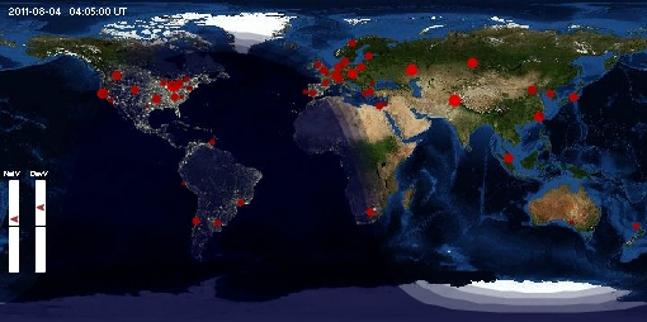 | **This is a picture of all the RNGs active around the world. The human consciousness project calls it the Egg Network. |
The machines are highly guarded from outside variables and are continuing to collect information. The Global Consciousness Project states on its website, “The probability is less than one in a billion that the effect is due to chance. The evidence suggests an emerging noosphere, or the unifying field of consciousness described by sages in all cultures.” On September 11, 2001, the RNG network collected a wealth of information during the events of the terrorist attacks. The deviations in the numbers spiked not only during the attacks, but for days after as the world mourned together. The deviations are subtle and the individual results are too weak to be confidently interpreted. However, the combined results of replications are gradually building a mass of empirical evidence. Data is still being collected, but it is too early to assume causation. The Global Consciousness Projects provides their explanation of the relationship: “The behavior of our network of random sources is correlated with interconnected human consciousness on a global scale”. This incredible discovery is another way in which the psychological connections of humanity are highlighted and the empirical evidence is growing. The connecting forces continue to stretch beyond the mental barriers and in to the realms of universal connections. | 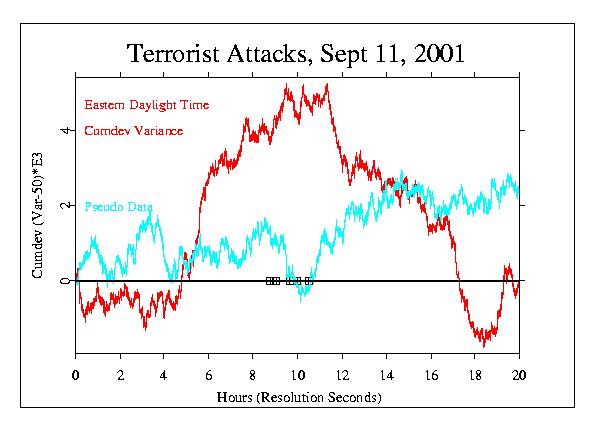 **The Human Consciousness Project is absolutely amazing and one should definitely check it out at: http://noosphere.princeton.edu/ |
Space time Connections
Space presents a great mystery, a mystery far from being understood by humanity. However, space does present some great truths. Recognition of some of the principles of space and time can assist one in determining further associations among humanity. Light does not travel instantaneously. Light travels at a finite, measurable speed. There is slight delay from when light radiation is emitted from the sun to when it reaches the earth. Light, unlike sound, does not need a medium to pass through. Nola Redd provides a nice summary of light and its connection to time:
The distance light travels in the course of a year is called a light-year. A light-year is a measure of both time and distance. It’s not as hard to understand as it seems. Think of it this way: Light travels from the moon to our eyes in about 1 second, which means the moon is about 1 light-second away. Sunlight takes about 8 minutes to reach our eyes, so the sun is about 8 light-minutes away. Light from the nearest star system, Alpha Centauri, requires roughly 4.3 years to get here, so that star system is said to be 4.3 light-years away.
A light year is the distance light travels in a year. Exactly how light travels through a vacuum, space, is still unknown. However, light and its connection to time present some fascinating observations that all of Earth’s inhabitants fall under. Gowan goes on to speak of these universal connections.
With our telescopes, we can see galaxies as they were billions of years ago, long before the Earth was formed. Conversely, distant galaxies can see us in every stage of the Earth’s history. None of this information is ever lost…It is the past half of the universe that everyone can see, but everyone sees a different past half. And we see part of the future that other galaxies will only eventually see; for example, we ourselves are now part of that future for distant observers. (7)
For example, if distant life in the nearest star system, Alpha Centauri, were using high enough power telescopes they might be watching President Obama and Senator McCain during a Presidential debate in 2008. Present time is to be the future observations of far-off galaxies once light has reached them from the current moment in time. This relation of time, light, and matter allows everything to exist and cannot be broken. If a mirror were placed out in space, theoretically people would be able to see their past. When people look up at the stars, they are essentially viewing the grandest of history books ever written, all of its novels intertwining into reality. All look into the same mirror. It shares the same past and same intangible connection. If distant life sees humanity as a single body, why can society not? The fleeting image of history, moving at the speed of light, is briefly visible as one looks out among the stars. Everyone is immortal in the vast expanses of space. Mankind’s history is constantly moving at the speed of light into the depths of space. This space-time connection supports the common saying to live in the moment. Society should love the Universe for the immense opportunity it presents and unite. In order to do this though, mankind must love one another and solidify its innate feelings of connection.

**Austrain skydiver, Felix Baumgartner, prepares to jump from twenty-four miles up on October 14, 2012.
**John Gowan's paper, The Human Connection, and other papers of his can be found here: http://www.johnagowan.org/human.html
The content of this paper and others are fascinating and worth a look.
Transition
Humanity
is connected whether people like it or not.
They all embody the same atoms, physiologically abstract upon the same
ideas, and are all under constant influence of the intangible space-time
connection. The connections have been
identified. All that is left is to
accept and funnel them into improving humanity.
Doing so is difficult though and provides immense challenges. Changing society’s ways involves altering
logical thought processes. The truth is,
mankind stereotypes individuals to save time and effort. Society uses cognitive shortcuts that allow rapid
decisions called heuristics (Science of Psychology). These are useful in general information
processing, however lead into stereotypes.
Stereotyping then leads to prejudices and discrimination. Not using these heuristics would cause
society mental strain and time, but it would be a beneficial sacrifice. Improving
the human connection would require all of humankind to reflect or abstract upon
themselves and these connections.
Unfortunately, this process can lead to questions of one’s own character
and the world itself. Questioning of
these elements often creates more questions and fewer answers as one struggles
to define one’s self. Some take this
grief and transform it into hate and anger.
This abstraction process also requires people to drop their inflamed
egos and accept that they are not that different from their neighbor. Yet, at the same time one must retain an
extent of their individuality to prevent an “Everyone belongs to everyone else”
(Huxley 40) mentality present in Brave
New World. If humanity can resist
the temptation to jump to conclusions and to separate as a result, it can
combine their efforts and unite as a whole towards the advancement of mankind. Bejan’s theory of Constructal Law can be
connected with Gowan’s ideas and help prove the worth of applying the human
connections.
Constructal Law
Bejan is a MIT graduate and current professor of the mechanical engineering department at Duke University. He has recently produced a physics theory that is shocking the physics community. His “Constructal Law theory is as follows, “For a finite size flow system to persist in time its configuration must evolve in such a way that it provides easier and easier access to the currents that flow through it” (2). This statement simply indicates that systems in nature of all kinds adapt to provide for maximal efficiency. If society can recognize the human connection as the next step in evolvement of efficiency, the possibilities for advancement are limitless.
Trees are one of the systems that Bejan first studied and are frequently alluded to when explaining other systems. Basically, trees’ branch and root design allows for optimal water absorption, sunlight absorption, and maximal glucose production through photosynthesis. Bejan and his staff manage and constantly publish new articles on current research and connections to the Constructal Law on “Constructal Theory Web Portal.” The website article provides the mathematics behind the efficiency of the tree design:
The tapered shape of the root and longitudinally uniform diameter and density of internal flow tubes, the near-conical shape of tree trunks and branches, the proportionality between tree length and wood, mass raised to 1/3, the proportionality between total water mass flow rate and tree length, the proportionality between the tree flow conductance and the tree length scale raised to a power between 1 and 2, the existence of forest floor plans that maximize ground-air flow access, the proportionality between the length scale of the tree and its rank raised to a power between 1 and 1/2, and the inverse proportionality between the tree size and number of trees of the same size all increase the efficiency.
Bejan uses a number of different properties and laws to calculate the dimensions and design of the tree branch components. This tree branch design has been applied to the reasoning behind the structure of the lungs and their networks of bronchi, bronchioles, and alveoli. It has also been applied to the system of river basins and their branches of tributaries. The connections continue with atmospheric currents, air traffic design, climate change, the physics of spreading ideas, and much more.
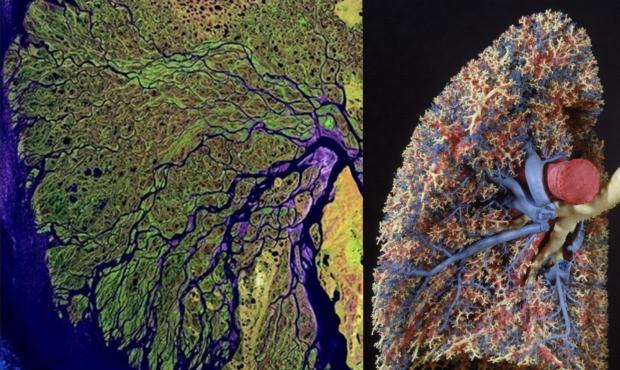 |  |
**Here the design of the human lung and rive basins are paralleled
Constructal Law is a modem in which the human connection can be proved as being the next step in mankind’s evolution. The second step in coming to this conclusion is recognizing society as a system. Bejan has applied his theory to trees, river basins, athletics, animal evolution, and more. But he has also applied it to society as a whole. Bejan states, “Society with all its layers and features of organization is flow system. It is a “live system,” perhaps the most complex and puzzling we know.” He goes on to say, “From such a position of singularity…it is a formidable task to see and describe the big picture- the lung, the river, basin, and the forest” (1). Bejan is absolutely right; the river’s path is often hard to determine when close up. By zooming out, an individual can determine its shape and function. Similarly, zooming out from the individualistic perspective of society helps identify society as a system that is applicable to Constructal Law. One might argue that, he or she is a strong individual and not a member of this “system,” despite what one’s government or astronauts might like to think. However, one must understand that unique characteristics of units that compose a system are irrelevant to the function of the network itself. Bejan explains, “No two leaves on an oak tree are identical, but they perform similar functions as members of the same tree system” (Bejan 36). In a mob, individual characteristics are canceled out. All of the units unite under a common purpose. This common purpose, in accordance with the growing rational choice theory, being “…to minimize the costs and maximize the benefits of their behavior…” (36). This theory of purpose is simple and all inclusive; humanity seeks to be efficient. Mankind shares similar functions with any other system in the universe, so why would it not fit? Lastly, Bejan asserts that all systems evolve toward efficiency. If they do not, they are replaced (36). Humans have yet to be replaced, so it can be assumed society is a valid member of Bejan’s “systems.”
Constructal LawBejan’s theory overlaps with a multitude of other theories. One relative concept is the golden ratio. The golden ratio can be interrelated with Bejan’s Constructal Law and Gowan’s human connections. Bejan distinguishes it as the product of a system’s evolvement toward efficiency, and Gowan’s principles of the necessity of pattern and diversity are also found in the concept of the golden number. This divine proportion describes a ratio depicted by a rectangle with a length about one and a half times its width. This ratio occurs when the smaller segment to the larger segment is the same as the larger segment compared to the sum of the two smaller segments. This ratio is believed to produce the most aesthetically pleasing shapes, and many artists and architects have fashioned their works around this proportion. Leonardo da Vinci’s Mona Lisa and Vitruvian Man have are configured around this ratio along with the ancient Roman’s Pantheon (“The Mystery of Golden Ratio Explained”). Bejan’s explanation for this phenomenon has to do with how humans perceive information most effectively. Duke University’s article “The Mystery of Golden Ration Explained” quotes Bejan on the subject: Eyes take in information more efficiently when they scan side-to-side, as opposed to up and down… As animals developed organs for vision, they minimized the danger from ahead and the sides…this has made the overall flow of animals on earth safer and more efficient. The flow of animal mass develops for itself flow channels that are efficient and conducive to survival – straighter, with fewer obstacles and predators. Bejan believes mankind’s evolution of vision, cognition, and movement is all tied together and all evolved simultaneously. The evolution of animals’ vision has in turn led to efficiency. Therefore, this phenomenon can be attributed to Constructal Law as well. Bejan states in the article, "Cognition is the name of the constructal evolution of the brain's architecture, every minute and every moment…this is the phenomenon of thinking, knowing, and then thinking again more efficiently. Getting smarter is the constructal law in action.” Evolution is constructal law. Bejan has just expanded on Darwinism and applied it to multitudes of systems beyond biological perspectives. Here, he ties into the golden ratio concept to principles similar to Gowan’s concepts of the human connection. Bejan goes on to say, “The phenomenon of the golden ratio contributes to this understanding the idea that pattern and diversity coexist as integral and necessary features of the evolutionary design of nature” (“The Mystery of the Golden Ratio Explained”). This ties into the human connection as society tries to achieve the balance between pattern and diversity. Humanity struggles to find its optimal niche between togetherness and individuality. Society must exhibit abnormalities in order to evolve. However, if these differences are persecuted, who is to say mankind will evolve at all? Even if these differences do not lead to efficiency, oppressing these deviations certainly cannot benefit anyone. The golden ratio is a perfect example of where the Constructal Law and the Human Connection meet.
**The golden ration has been oberserved in Leonardo Da Vinci's Virtruvian Man, Stonehenge, which was constructed an estimated 4000 years ago, and the Great Pyramids, which were built an estimated 4600 years ago. **Check out all the different things constructal law has been applied to at: http://constructal.org/ | 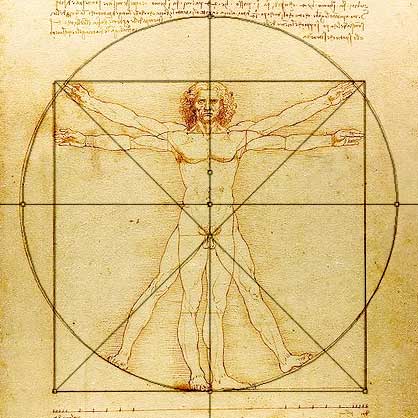 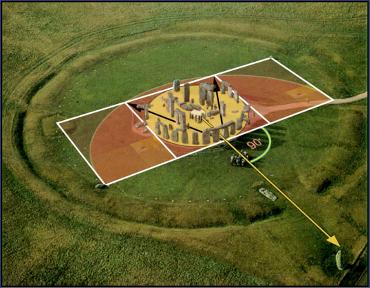 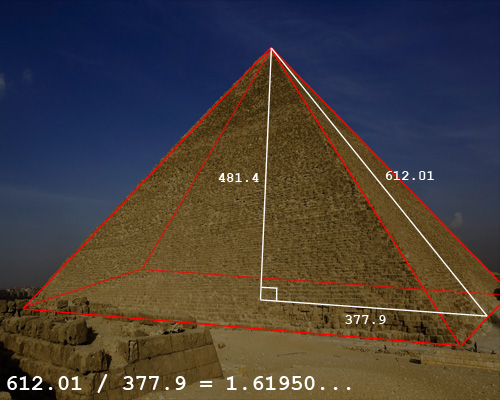 |
Conclusion
Bejan’s Constructal Law has been tied into numerous other fields of study and continues to shed light on the reasons for the patterns observed in everyday life. He has connected his theory to social networks as well and believes the nodules connect and operate similar to tree systems (36). This concept ties back into the development of the six degrees of separation. The degrees of separation are decreasing, and the globalization of the economy is reigning in these degrees and connections. The web of human connections is continuing to become more inclusive and spread. Constructal law points to the tree like structures as indications of efficiency. A measure of global efficiency would be difficult to define. However, one could say the world is developing but still struggling to put an end to problems that have plagued mankind since the beginning of time- racial and religious persecution. The problem is, people do not realize these six degrees of separation reach much deeper than a name association. Physical, psychological, and universal bonds are unavoidable and correlate all of mankind. These are the connections that must be applied to achieve maximum efficiency. Constructal law leads one to believe that if one can recognize these associations, one can improve the world as a whole
 |
"A human being is part of the whole, called by us "universe," a part limited in time and space. He experiences his thoughts and feeling as something separate from the rest -- a kind of optical delusion of his consciousness. This delusion is a kind of prison for us, restricting us to our personal decisions and to affection for a few persons nearest us. Our task must be to free ourselves from this prison by widening our circle of compassion to embrace all living creatures and the whole of nature in its beauty." -Albert Einstein |
Sources
Bejan, Adrian, and Gilbert W. Merkx. Constructal Theory of Social Dynamics. New York: Springer, 2007. Print.
"Carl Sagan Quotes." Carl Sagan Quotes (Author of Contact). Goodreads Inc. Web. 16 May 2012.
"Constructal Theory Web Portal." Constructal Theory Web Portal. N.p., n.d. Web. 01 Oct. 2012.
"Global Consciousness Project." Global Consciousness Project. N.p., n.d. Web. 06 Mar. 2013.
Gowan, John A. "The Human Connection: Physical and Metaphysical Connections to the Cosmos." The Human Connection: Physical and Metaphysical Connections to the Cosmos. Web. 15 May 2012.
Guare, John. Six Degrees of Separation. New York: Dramatists Play Service, 1992. 81. Print.
Huxley, Aldous. "Ch. 3." Brave New World,. New York: Harper & Bros., 1946. 40. Print.
"The Mystery of Golden Ratio Explained." EurekAlert. Ed. Richard Merritt. Duke Univeristy, 21 Dec. 2009. Web. 1 Oct. 2012.
Palahniuk, Chuck. "17." Fight Club. New York: W.W. Norton &, 1996. N. Print.
Redd, Nola. "The Speed of Light." Space.com. N.p., n.d. Web. 27 Nov. 2012.
Science of Psychology An Appreciative View. McGraw-Hill Humanities Social, 2011. Print
